
Need a primer on capacitors, including what they are, what they do, capacitor value codes, decoding plastic or bakelite round (bumble bee) capacitors, decoding mica capacitors, capacitor polarity, etc.? Click HERE to be redirected to a useful technical resource on capacitors written by member Joe Coco, proprietor of wjoe.com, the club resource for vintage electronics restoration parts, including capacitors.
Quick reference guides on capacitor value codes and decoding color-coded plastic or bakelite round capacitors are immediately below. Click on any of the below images for more information from wjoe.com.
Capacitor Value Codes
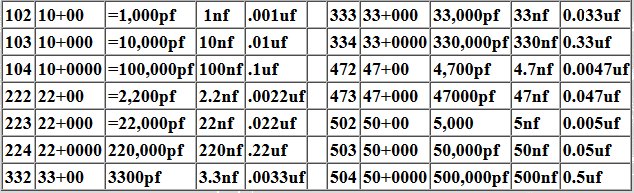
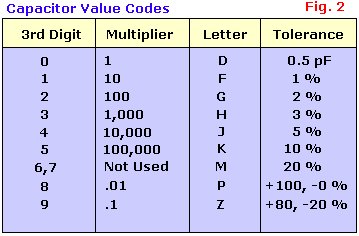
Capacitors with 2 or 3 digits followed by one or two letters written on the body are decoded as follows: From left to right, the first two digits are multiplied by 10 raised to the value of the 3rd digit. The third digit represents the exponent. Thus, the product of the first two digits x 103rd digit value is the capacitance value in pF (picoFarads). As a shorthand, the third digit specifies the number of “0”s that follow the first two digits. The following two tables offer examples and further detail the 3rd digit meaning and capacitor tolerance codes.
hidden
Capacitor Value Code 3rd Digit and Tolerance Codes:
hidden
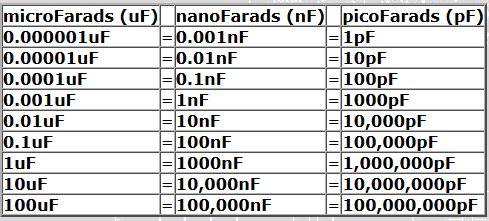
Other capacitors may just have 0.1 or 0.01 printed on the body. If so, this represents the capacitance value in microFarads (uF). The table below summarizes conversion between picoFarards (pF), nanoFarads (nF) and microFarads (uF).
hidden
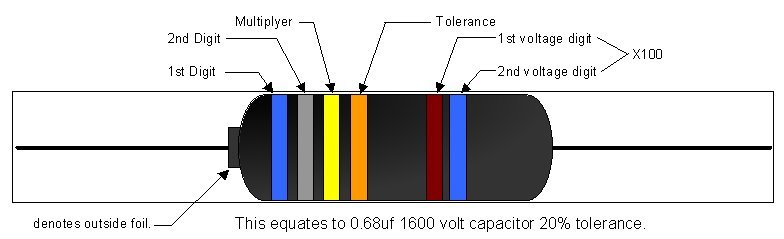
Decoding Plastic/Bakelite Round Capacitors
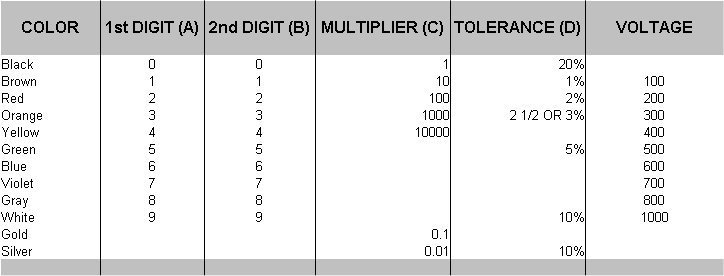
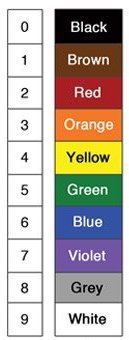
Color-coded capacitors may be decoded using the table below:
No op
Decoding Old Mica Capacitors
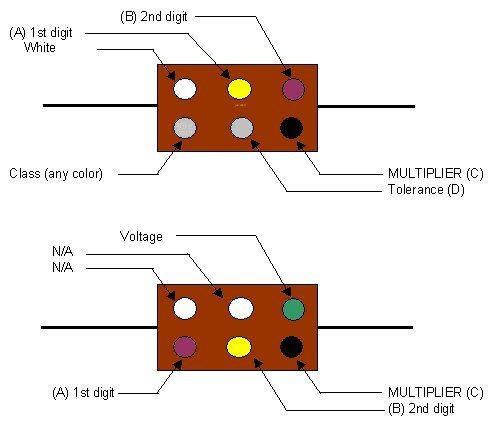
The below diagrams describe decoding Mica molded type capacitors. Mica capacitors are typically expressed in terms of MMF (micromicrofarads), which is equivalent to picofarads (pF). Use the above color chart to decode the color values, where the resultant capacitance value is in units of pF / MMF. The first example immediately below translates to 47pF or 47MMF.
The diagrams below depict two methods, where the first step is to identify the starting point. During decoding, if your capacitor value starts with 9 and a multiplier of 7, then there is a decoding issue.
Note that the “N/A” positions may have no color, and this applies to any spot that has no purpose (and thus doesn’t apply). Also, this is just a quick reference; there are plenty of resources on-line to assist with decoding the various types of mica capacitors.
 NEVEC
NEVEC 